Mostrando entradas con la etiqueta Español-Inglés. Mostrar todas las entradas

miércoles, 11 de enero de 2017

Why

Real Madrid is living an "every man for himself" situation whose script marks the chance of the wind that blows the cornerstone of all this mess on the head: José Mourinho. The Portuguese man arrived last summer in the Santiago Bernabéu because Florentino Pérez dug his heels in about him and paid 16,000,000 euros to the Inter. The president's change of heart in these years seems curious when formerly he thought the galactic guys were trained on their own, that it all was reduced to putting the trading cards onto the field. The example that illustrates it all is when he fired Del Bosque whereas he celebrated the League in the locker room (he had won two Champions' Leagues before) to bring a blue-look man, Carlos Queiroz, whose achievement until then had been to be a coach's assistant.
The thing is that Pérez signed Mourinho up in a unilateral and real personal way passing over the person who deal with these needs, Jorge Valdano. The president, once more, has to shut his trap. He'd said tens of times that he didn't know about soccer and that those decisions belonged to Valdano. Well, no: Valdano aimed for Pellegrini's but he was brought Mourinho. The nitty-gritty of the thing is the Argentinian and the Portuguese man kind of fell out over some columns in Marca. "Quien no tuvo talento para jugar no cree lo suficiente en el talento para improvisar soluciones", May 2005; "Mourinho es un carisma andante que no sabe muy bien lo que representa", September 6th 2008. That is right, the presentation of the Portuguese man was sort of rare. "We already sorted it out", "everything's in order"... Valdano doing his stuff and Mourinho not bluffing in the least. If something is clear is that the Portuguese man passes on shows.

Just as the season was drawing on, Mourinho was accumulating power. Even more than whatever he could imagine at the beginning. In fact, a coach of Mourinho's strength isn't remembered. The grandstand and the loudspeakers of the Bernabéu amuse themselves with his good name. He accumulates all the prominence over the figures of the team. Everything with an advertising speech full of incongruities but very populist: fans fight to the death with him. What young boys in Madrid's scarves boast about in bars, Mourinho did live, before twenty television cameras and with repercussion all over the world. The issue was to look for a fight. A continuous weekly wallop with whomever passed by: Pedro León, Preciado, Unicef, referees. One of his favorites was Valdano, who was in theory Mourinho's boss, but he suffered his subordinate's mobbing. First he forbade him to go in Valdebebas, afterward he didn't let him travel in the same plane as the team... The Argentinian changed from Real Madrid's general director, Florentino's second-in-command, to the person in charge of caring for the mikes of Canal Plus in the breaks of the games with an annual wage of 2,400,000 euros. More than half of the players of the first squad. Mourinho had turned Valdano into that. Things were already nice and warm formerly with that thing about journalistic articles, but the Argentinian refusing Mourinho's delusions of doing both the Portuguese team and Real Madrid simultaneously was the last straw that broke the camel's back: they stopped having any communication, Valdano got tired of asking for three-party meetings with Florentino Pérez to solve the issue but his request was never cared for. The day Mourinho stood up to the press, after this one dumping him, he came up before everybody and said to the mikes that he'd only speak with the media directors. Curiously he didn't exchange any words with his director, Valdano.
And what was Florentino doing meanwhile? Well, nothing, doing his own thing; preaching the good name of Real Madrid and his own. He's a superior being, or at least that's what Butragueño says. The president's error is brought because he'd always surrounded himself with a series of parapets that took up all the criticism and did as a defense wall, namely: Valdano, Sacchi, Pardeza... He has Zidane, one of his favorite associates, they say he's an exception reporter from the locker room to the office in his times of player. But you don't have to fool yourself, Zidane doesn't mean a thing; he's a figure to take the pictures who isn't going to hold up in the least the direct line that Mourinho has now with Florentino. The trainer said it in March: "el discurso del rey Florentino es importante para mí". Then, Valdano out, the King ran out of all the pawns, all the defenses. Mourinho deciding to put him in check only depends on him.
Guardiola said it and we were surprised at it: "él aquí es el puto jefe, el puto amo".

viernes, 16 de diciembre de 2016

Great supporting actors: Richmond Avenal ("The IT crowd")

Monty Python’s Flying Circus, Yes Minister, Red Dwarf, Blackadder, The fffice, Black books and so many other outstanding TV shows along the last decades have been raising the genre of British comedy until it was turned into a real reverential totem in television history. The IT crowd, born in 2006 and its fifth season waiting for broadcast this 2011, has been one of the last pieces to join such prestigious humorous building. Even though, now, it has from the basement. Because it's in the IT department (IT: information technology) located in the deepest of Reynholm Industries' building where the hilarious misfortunes of Roy, the lazy immature Irish man, get sparked; Moss, the misfit naïf geek; and the boss of these ones, Jenn, superficial, incompetent and obsessed to be successful in a company that practically disregards her existence. In a microworld of extreme personalities and insane situations it could look unlikely that someone showed up to surprise with their eccentricity. But then Richmond showed up.


Richmond Avenal is the fourth pillar of the very unbalanced IT Department. Episodic character, he lets himself be seen just in some episodes of the first two seasons but such is his charisma that he's capable of turning each one of his appearances into a gallant exhibition and genuine supplier of gags. Pale and gaunt, always in black clothing, he's drawn up as a nonsensical performance of a perfect subcultural Goth, halfway among a take-off of a classic vampire, a phantom of the opera's and design Tim Burton's. Melodramatic, spiritless and depressive, he gets to be anticlimax become humor. Permanently putting it the unexpected black effect to the chromatic frenzy which makes up the mixture of characters and plots of The IT crowd. But as every projected goth, Richmond wasn't always like that.

As it's told to us in his first appearance in the show, Richmond, some years before, was a talented hard-working yuppie whose feats had led him to a meteoric major in Reynholm Industries till he became president Denholm Reynholm's right hand. Everything was running smoothly, feeling fulfilled with the professional successes and ambitious projects to command, until, a fateful night, he discovered Craddle of Fith. Little by little, with the blow of extreme metal songs, the dark goth mutation was happening in him, which finally made incompatible his work among the well-dressed minds of the corporate height. Fallen from grace, he was degraded into the IT department, where, in turn, Roy and Moss, quickly fed up with their new partner's behavior, set him aside to the "important mission" of supervising a little dark room where the old central computers are located. And there he remained forgotten for a long time until one day Jenn discovered him by accident and invited him to get back to the living world. This way, Richmond gets to embody the misfit among misfits, the last element of the social and labor structure. And from there, he rises up touching for defenseless, but gloomily comical at the same time, in order to perform in a magnificent way the role of sad clown inside of the The IT crowd circus. A series of compulsory view that, to that person whom it doesn't work as great amusement, there is only one solution to set out: did you try to turn it off and to turn it on again?

sábado, 10 de diciembre de 2016

"Burbujas"

It is strange to review some work of this author starting by almost the most newly-made and different of his work, but we felt like it. Burbujas is maybe his most atypical and personal work. Daniel Torres, from the new Valencian school, with his clear line style, is recognized by characters rather of the genre such as Roco Vargas, writer-adventurer from a retro-futurist universe or Tom, the children's tales' dinosaur. But by this work, he moves the character's accent into the story, from the eidetic-fantastic to the real-human thing. It is very easy (although depending on the reader's generation) to identify themselves with the main character, we could all be Ramón: nothingy man, who's been going through half of his nothingy life, steps on the brakes when having a thoughtful Epiphany in front of a huge fish bowl. Absurd as it may seem, the metaphor looks suitable and beautiful; this, and the subsequent ones the author overwhelms the character with to solve the Gordian knot of his existence, will flood a large part of this story with thoughts (bubbles) that will attempt to give air to varied vital concerns. Filled with biographical and autobiographical notes, the final result is a close work, with points of humor and worked with lots of affection and sensitivity. Burbujas is maybe as necessary in the author's story itself as in the character's and, very likely, it was or it will be in one scatterbrain or another.

viernes, 11 de noviembre de 2016

Is Messi better than Maradona?

Brief answer: no.

Reasoned answer: Manel Estiarte says in the interview that he's conceded us that Messi is not already comparable to Maradona, but even better. He's not the only one who thinks so and, besides, he gives his good motives to it; which may be, in my opinion, arguable, but they're also reasonable. I think that Messi is, of course, the best soccer player at present, but I underscore the "at present" thing: I understand that, in the height of fever of the present and in a discipline of historical memory as brief as soccer is, parallelisms favor the most recent player.

Estiarte also says, subscribing to a comment that Michael Robinson made us in that sense, that current Barcelona is the best team he has ever seen —and I'm not going to discuss that because it's possibly one of the most serious candidates— and here is where we can start unstringing comparisons: Messi can do exceptional things as much technically as statistically (number of goals, for instance) but he does rallied around by a team that counts on the best top in almost all of the posts at the world level. In fact, contemplating the amazing level of the team he plays in, Messi not providing with his good bunch of goals and fantastic plays would be pretty inexplicable. Let's imagine Romario or Van Basten in this same team. Barcelona is such a good team that no-one could understand that Messi didn't make such an impression.
But Maradona never played in a team of such quality. Never, not by a long shot. The best team where he was was precisely Barcelona, but hepatitis and Goikoetxea's brutal kick, a little harder and he takes him off soccer, stopped Maradona from reaching glory in the city of counts. His biggest successes were gotten in teams that, overall, pale next to the current Barcelona (and even next to the Barcelona that he went through) and, in fact, it wouldn't be exaggerated to assert that, without Maradona, they were teams of the bunch. The Naples where he forged his legend was basically a coarse crew built up around him: there were no Xavis or Iniestas to make him things easy. In fact, it was Maradona who performed as Xavi or Iniesta for the rest of the team, at the same time as he played Messi, too. The most similar to a star that Maradona had beside him was the Brazilian Careca, and that wasn't it until his second Scudetto. Besides, we talk about the Italian league of the 80s: catenaccio, merciless defenders (in all senses) and soccer absolutely opposed to the fluency the current Barcelona gets (and they get it not only because they're a great team, but also because soccer has "melted" —fortunately!— and circumstances allow them to). Soccer from the 80s was hard, and nowadays the press and public would kick up a real shindy if, in just one match, defenses subjected Messi to a 50% of the fouls and kicks Maradona was regularly subjected to.

The Argentinian team from 86 wasn't a memorable team either; almost all the comentators agree that Mexico's World Cup became not Argentina's, but Maradona's world cup, and that it was practically the only occasion when only one player's talent led a team to victory (that's to say, quite the opposite of the grouping soccer that gave triumph to Spain, for example). But let's be fair and let's wait in order to check what Messi can do in the world cups of the future. For the time being, let's do the only comparison we can do: Messi's South Africa's World Cup leaves a lot to be desired before Maradona's World Cup 82 (which was generally considered a disappointment, that much was expected from Maradona at the age of 22). In only one match of the year 82 —for example Argentina against Hungary— Maradona showed quite a lot more things than Messi did in all his last championship. Diego, I remind it again, was 22 years-old back then. The video library is there, in case someone wants to do something other than comparing on paper and see it with their own eyes.
The idea of Maradona's perpetual irregularity is a myth created in the years when he indeed started to be irregular. But before those years, in his age of glory, Maradona didn't fail. And he didn't fail because he wasn't a player of flashes as Messi may be; Maradona wasn't a forward, not even a midfield: he was a classic midfielder that wasn't near the area waiting for balls, but behind it, giving balls to the waiters. He was someone who was in not very exceptional teams, who constantly depended on the play he shared out and organized: if Diego didn't work, the team didn't work (that can hardly be said about Messi and Barça, of course, because the rest of Barça can perfectly play on its own). Maradona made passes for others to follow the play, for others to score goals. Even so, despite that dependency on him, he got to win Calcio titles and the UEFA cup, a tourney that was back then almost as hard as the European Cup, current Champions League. An irregular Maradona would've never gotten titles with those teams. And as if that weren't enough, in addition to being the team's heart, he had time and talent to frequently score his won goals and give us all sorts of extraordinary individual plays, too. And I think that it's those individual plays that mislead many by making them believe that Maradona was «that» kind of player.
When Messi is likened to Maradona, he is because of the most apparent similarities in the technical qualities of both of them, which are exceptional, but very especially for dodges and the ball conducting. Visually, Messi's style with the ball reminds a lot of Maradona, but beyond that there's a fact that people usually forgets: they're not the same kind of player. They don't play the same role or play in the same post. Maradona, necessarily, needed a more complete technical repertoire. The great Diego Armando —I repeat the idea again— was equal to Messi plus Xavi plus Iniesta. Literally. He did on his own what these three players do overall and they couldn't do separately. His dodges or his goals were just the most striking part of his game, but then it's his fantastic effectiveness in all sort of passes (short, long, triangulations or distribution... of any kind), his view of the game, his ability to make team decisions in a tenth of second and the way he could lead the rest of colleagues by sharing the game out from the central circle. And he continuously did, not by bursts. All the game passed through him and that is something Messi doesn't do in Barcelona. In fact, Diego himself made the mistake to expect Messi to perform as Maradona in South Africa: it didn't work, of course. It's not a question of age or Messi being still too young to be able to compare with justice: it's that they're not comparable players, they don't have similar functions, they don't have identical repertoires. That is not Messi's game; Lionel isn't by a long shot as technically complete as to develop all of his countrymen's functions. It'd be like asking him to shoot in fouls with the same poisonous danger as  Maradona used to: Messi can't do it, there are things Diego could do and he can't. And there's nothing wrong about it, nobody can do all that Maradona did. In Barcelona they need several players to do it. In Madrid they aren't even doing it with several players. In any team of the world they might need several players to even try.
And finally —more subjective, but not less important— there's what Maradona means in soccer history and, even with the benefit of the doubt, it's quite unlikely that Messi gets to mean it some day. And there is, for sure and allow me the poetic license, romanticism too. Messi is a son of Argentina but a pupil of the masia: he grew up as it must be, rallied around in one of the best schools of the world —if not the best— and he plays, as it must be too, in the best team of the world. It's like the Lewis Hamilton of soccer. But Maradona, a son of Argentina too, is instead a product of the unknown Cebollitas and, basically, no-one's pupil. His natural talent flourished by itself in the middle of the roughest origins and, as if the rough were his fate, he always reached glory in adverse soccer circumstances.

The only thing I know is that comparisons began to shoot up with that magnificent goal of Messi's to Getafe which reminded so much of Maradona's famous "goal of the century". Maradona just did it against England —not against Getafe—, in the heat of a world cup —not in the Copa del Rey— and in the tense rematch of the Folklands' war —not in a routine round of national competition between two very unequal teams—. When it's said that it's unfair to forget Messi is still very young to compare, I wonder, instead, if it's unfairer to forget that, to be able to put a player in the same phrase as Diego Armando Maradona, that player has to demonstrate the practically indemonstrable thing. I am the first one to long to see a new Maradona appear. But I haven't seen him yet.
I'd also like to believe in God, but I haven't seen him either.
Or I have.

domingo, 23 de octubre de 2016

"Camelot"

The new series of the Starz channel about king Arthur Pendragon's legend was one of the "white hopes" of the TV 2011. Some episodes already broadcast in the United States, the result is unequal: it surprises positively in some aspects, it disappoints in others and it fulfills simply the terms in the main thing. It's always difficult to move Arthur's myths to the screen in a convincing way and some times the size of the wild dream becomes spectacular: good examples is the priceless youthful amusement of the recent series Merlin or the pseudo-historical nonsense of the laughable King Arthur (yes, that drivel where king Arthur was a Roman legionary). But even for a more serious adaptation effort —as Camelot is— turns out to be complicated being at the height of versions that became practically unbeatable (I'm naturally talking about John Boorman's flawless Excalibur: it'll be difficult that somebody beats that adaptation someday). But, comparisons aside and with all of its defects, at least it can be said about Camelot that it belongs to the group of respectable versions. There's nobody here  ambling around dressed as a Roman.

It's an entertaining series. Which is not little. The scripts are fluent, with a good balance between dialog and action; besides there are some intense and surprising sequences in every episode. The only storyline noticeable defect is certain tendency to rewrite some classic chapters of the most known versions of the legend, which doesn't usually work with popular myths. It's the danger of trying to becoming "original": a handful of screenwriters will difficulty find better solutions in some months than all an oral and literary tradition along the ages. But if we except the failed licenses of the script, the series is well constructed, it's relatively intelligent and it never bores, quite the opposite.

Eva Green in her fascinating characterization as the witch Morgana.
What almost —and I say "almost"—manages to ruin Camelot's final result is the cast: a channel such as HBO and its fantastic casting policy could have turned this series into something monumental (see Juego de tronos) but it's hard to imagine what Starz's persons responsible were thinking of when they cast Jamie Campbell Bower as king Arthur himself, a little blonde childlike guy coming from the Twilight saga. Terrible. Joseph Fiennes isn't such a correct Merlin either and queen Ginebra turns out to be equally dull, just naming some main characters. Even though, we've got to say all of it and now's when we get to the strong point of the series, Camelot can boast about having had one of the wisest casting moves of the last years: Eva Green performing witch Morgana. What a triumph. The French actress so effortlessly beats the rest of all of the cast; she's just a couple of stepping stones over the rest of them all. Camelot is going to become Eva Green's vehicle of personal show: we already knew well the sexuality of her appearance on screen, now, besides, we know the reach of her talent and her charisma, too.

To sum up, Camelot is a good series with an irregular cast: an option to consider for epic drama lovers or simply for those who're looking for effective entertainment; you won't feel disappointed. If and when, of course, you'd like to start yearning for Excalibur's supernatural aura... but let's not be picky: it'd be too much to ask for a television series to build whole sequences around Götterdämmerung.

sábado, 17 de septiembre de 2016

"The man who fell to Earth"

The scarce inhabitants of a dying planet (called Anthea in the novel, though presumably it's about Mars) bring their last material resources together to send an explorer to planet Earth. This explorer, of an almost identical to the human one's race and who, while he camouflages himself among earthlings, will be named Newton, has the mission to use his technological knowledge to search various patents that allow him to earn an immense fortune. With that money, and in total secret, Newton will try to build a spaceship to rescue the scarce survivors that have remained in his world —including his own family— and bring them to our planet to guarantee them a future with.

Under this more or less stereotypical premise, Walter Tevis built one of the most original emotional novels in the science-fiction genre. The alien of his story, despite his technological superiority and his sharp intelligence, will be the victim of his ferocious non-adaptation to this world of ours, which looks strange and threatening to him. Not only the earthly gravity will make him prone to bone breaks and to feel pain by any sudden movement, but constant loneliness and dread that his real identity is discovered lead him to a destructive lining up process that winds up turning him into an apathetic bitter alcoholic individual.

The man who fell to Earth is one of the novels that set the alien topic turnaround in science-fiction: the extraterrestrial isn't just a threat or a superior being willing to guide and re-educate mankind anymore, but a being captive of our same fears, for whom contact with human race seems terrifying and psychologically destructive. In fact, the main character of the book is human —his anatomical differences with earthlings are minor; his emotional differences too—, and he's human even in disorientation and the constant feeling of defenselessness that he experiences on seeing himself surrounded by a culture that he finds it hard to understand, as it may happen to any immigrant. The tone of tragedy is what differentiates this book from other literary experiments similar to Stranger in a strange land by Robert A. Heinlein's style: in that book of Heinlein's (absorbent intelligent reading, nothing to do with his celebrated but arguable Starship troopers) the alien had important lessons to transmit to earthlings. In The man who fell to Earth, however, the only thing the extraterrestrial has to show us is some technological superfluous novelties because he can't give us any lessons on all the rest, feeling as lost and confused as ourselves, or more.

To sum up: The man who fell to Earth supposed a refreshing turnaround for the genre in a historic moment when science-fiction needed to transcend technological fantasy towards a more humanist perspective. There exists an irregular cinematographic version starred by David Bowie (who isn't a great actor but he looked surprisingly suitable for the role) but the point is that the movie leaves something to be desired and it doesn't capture the multitude of nuances of the original. The book, however, is the sort of novel that even those who aren't usual consumers of the genre may like. Very recommendable.


jueves, 15 de septiembre de 2016

"Der Vorleser"

I guess that everyone has a curious story about a book. This is mine: while being on vacation in Dubrovnik, I was left without anything to read. To see if I struck it rich, I went into the first bookstore I saw and I looked if there was a section of books in Spanish. And yes, there was. But they only had Lucía Etxebarria's complete works (why?!) and this one. And I chose this one, of course. I was to start its reading and not to drop it till the end. A beautiful wonderful easily-crying story. In the post-war period Germany, a teenager begins his sexual life with an attractive mature woman. Then a spectacular storyline turnaround happens and not more stuff can be said without squashing the surprising ending. A pretty decent cinematographic version starred by Kate Winslet got to be made. For eight or nine dollars it's available in any neighborhood or public transport station bookstore. In general, everyone usually loves it. In any case, it's not annoying reading. You may see.

"Treasure island"

No, we're not wrong: we're more and more convinced that it's not a work for children or young people. It's about a product of broad spectrum, like those games on whose box it reads "from 8 to 88 years"; see pachisi or the Goose game. Forget about the numberless cinematographic adaptations that you might've watched and read it without any prejudices or preconceived ideas, as if it had been edited for the first time two weeks ago. You will discover a novel with multiple reading levels: from the analysis of human greed to the initiation voyage, going through a harsh adventure novel. It comes in useful: you can read it to the kids so that they sleep happy and, thereafter, enjoy the intrigues among the characters as if you were reading Les liaisons dangereuses. I did not read it till I was 40, practically compelled by a literature teacher friend. Don't make the same mistake, even more so when we're insistently warning you what you are missing. We insist: it's not a joke. In addition, it can be found in a thousand editions: from those that cost one little dollar with the Sunday paper to the extended and commentated on ones. There is no excuse, come on. And if you're not convinced yet, at least don't deprive your children of such pleasure, who knows what a generation we're raising with su much Geronimo Stilton.

miércoles, 7 de septiembre de 2016

Vynil records' coming back

Luis Beltza is Beltza Records's owner, a legendary record store from San Sebastián specialized in vynil records' buying and selling. We speak with him on the occasion of collectors and DJs' renewed interest in this classic format, that not so many years ago seemed destined to a sudden extinction. However, according to Beltza, this renewed attachment to vynils is relative: «el interés se centra, por el momento, en los medios de comunicación». Specialized stores don't seem to be benefiting it, since «no repercute nada en las ventas, estas siguen siendo cada vez menores hasta límites que pueden llevar a más de uno a cerrar nuestras pequeñas tiendas de discos. La situación es más que preocupante». Paradoxically, a renewed demand is harming the traditional sector because «el vinilo vuelve a estar en las estanterías de poderosos y las grandes superficies, por lo que hay que añadir más competencia».

Collecting is one of the latest resistance bastions for specialized stores, but «es algo muy serio, que cuesta mucho esfuerzo y sobre todo un desembolso económico muy importante. Los coleccionistas han sido, son y serán siempre los mismos». It's a minority of buyers that, on their own, aren't enough to hold the viability of these shops. There are products that will always look attractive to vynil buyers, such as The Beatles, since «cualquier ítem relacionado con los chicos de Liverpool es objeto de coleccionismo», but public in general keeps opting for more comfortable formats, digital formats.

MP3 is the great enemy, given that «la gente lo quiere todo barato y rápido, a ese "precio": más barato que gratis es imposible», and it seems it matters little to MP3 consumers that «la calidad tiene que ser infinitamente inferior, ¡pero es gratis!». To Beltza, MP3s are an example «de lo que la gente demanda» and not only about music, but replying to a general pattern of cultural superficiality in a society where «esto se puede aplicar desde la política a los medios de comunicación: los contenidos y el arte de calidad brillan por su ausencia». Average listeners don't seem to appreciate the resonant shades of what they listen to, because there's musical education left and «tal vez la capacidad auditiva del individuo no esté preparada», which explains «un MP3 al que le faltan cientos de frecuencias» to be accepted.

Beltza accepts that vynil records is just appreciated by a select well-trained minority of listeners, because to appreciate to the fullest their resonant qualities «hay que tener una sensibilidad particular, un interés importante y un buen oído: con estos requisitos puedes llegar a diferenciar un abanico mucho mayor de sensaciones auditivas». And even though commercial CDs —not MP3s— have a very good sound quality, for demanding melomaniacs vynils are still a perfectly valid option: «Escuchar un CD es como viajar en línea recta por una estupenda autopista sin ningún riesgo, mientras que pinchar un LP es recorrer viejas carreteras comarcales plagadas de curvas sin ninguna prisa por terminar el viaje. A partir de aquí el conductor elige el camino que más le interesa».


lunes, 5 de septiembre de 2016

"Viajes morrocotudos en busca del Trifinus melancolicus"

One of the biggest sins of the Spanish average reader is the complete forget some of our traditional genres are submitted to while they give in to the literary fast food of the moment as if all that doesn't smell new and doesn't come wrapped in a brilliant cover newly printed didn't deserve their attention. And, however, the world of "minor" genres is filled with surprises to rediscover. One of these genres is humor books, that during the first half of the 20th century lived through a development in Spain from the hand of some names that, at least back then, achieved great popularity. Juan Pérez Zúñiga is one of those names and Viajes morrocotudos en busca del Trifinus melancolicus is doubtlessly a book unfairly ignored by current readers.

The novel —if it can be called a novel— is really a tour de force of todger humor; a sort of literary precedent of Dumb and dumber filled, fifty-fifty, with sparkling wit and with cheap jokes that aren't less effective 'cause they're cheap. Viajes morrocotudos en busca del Trifinus melancolicus is the real funny chronicle of a trip starred by Zúñiga himself and the illustrator of the book, the great Joaquín Xaudaró, who set off in search of a strange unknown animal species, the Trifinus melancolicus. Both protagonists, that are hardly on the verge of misery in Spain because of their scantily profitable literary activities, accept the order from an eccentric scientist willing to finance an ambitious biological expedition, and like this both of them travel around the world trying to figure out what kind of animal that mysterious Trifinus is. Which, of course, is only an excuse to mock all of the known civilizations resorting to hilarious clichés about races and nationalities in a rather little politically correct way (still today I giggle when I remember the chief of the African tribe decently dressed up, as a sign of refinement, in a sumptuous diaper).

Viajes morrocotudos en busca del Trifinus melancolicus is decidedly casual amusement deprived of ambitions, which confers it a dominating aura of irresponsible literary mischief. It's doubtlessly a delicious sign of the minor genre of intelligent stupidity, halfway among Mortadelo y Filemón's childlike pranks, the brothers Marx's hysterical Surrealism and Pedro Muñoz Seca's linguistic cleverness. As if the Monty Python had starred Around the world in eighty days or as if Homer Simpson had written En busca del doctor Livingstone, Pérez Zúñiga fashioned the most delirious travel book that I have had the chance to read. The writer from Madrid had doubtlessly humor in his blood and he gets his prose to seem to have been born funny in a completely natural way, something that is actually such a difficult effect to get.

Viajes morrocotudos en busca del Trifinus melancolicus is the perfect way of spending some good time out of touch with the sad reality, burying ourselves into a world where all of the individuals, from all of the countries and all of the cultures of the Earth, are invariably a herd of cretins.

An adorable gem of the national humorous literature.


martes, 2 de agosto de 2016

Forgotten cartoons

There's a whole universe of cartoons that moved from the page to the silver screen losing more or less dignity in the process. The audience has only kept in the popular memory dark knights, wall-crawling neighbors and people with such colorful job uniforms as to command a carriage on Pride's day. But there's cinema with a soul of faith beyond capes and superpowers.

Forgotten cartoons: review of some comic adaptations to the big screen that get out of the superheroic  cliché.

Scott Pilgrim vs. the world

Edgar Wright (Shaun of the dead and Hoz fuzz) undertakes the hard task to adapt six volumes of epical twenty-year-old adventures classified in the esthetic of old school video game.

The result is funny and it has nasty rhythm (with some memorable shot changes), cutting out a lot on the way and taking a lot of liberty but, at the same time, being extremely faithful in accurate passages and providing with witty ideas such as giving visual shape to onomatopoeias to have fun by playing with them.

The choice of Michael Cera to bring the shameless main character to life throws off, Mary Elizabeth Winstead's look's goes down well.

And so thoughtful of him: for once in a work that uses fictitious groups' fictitious music, the songs that were created to that effect don't make you cringe. But quite the opposite.


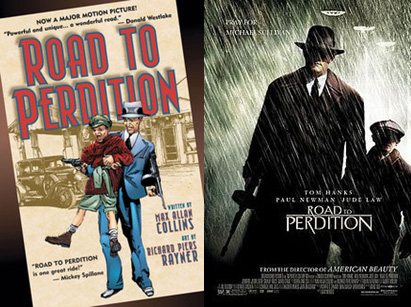
Road to perdition

Sam Mendes's movie starred by Tom Hanks, Paul Newman and Jude Law was an adaptation of a comic of an identical title written by Max Allan Collins, who in turn drank, and a lot, in the legendary manga 子連れ狼.

The comic had two sequels and the movie, a deconstruction of noir genre, was nominated to six Oscars and it got cinematography's with some staging inspired in Edward Hooper's pictures. Both comic and movie are appealing, despite the fact that the film script, on undergoing several re-writings, moved slightly away from the original material.


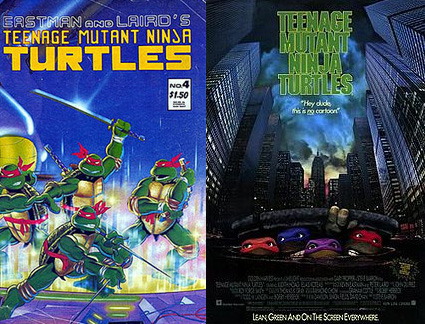
Ninja turtles

90s icon par excellence, the turtles had their origin in a 1984 comic pretty much more boorish than the movie: the pages began as a Daredevil's greenish parody and, in the mid 90s, when the work passed at the hands of the Image publisher, the stories were degenerating into dark violent amusement: Leonardo lost his hand, Splinter turned into a bat, Raphael saw his face disfigured and later on turned into Shredder and Donatello was rebuilt in the shape of a cyborg.

The first real action movie adapted the pages by lowering the tone and by adding hateful surfing clichés (pizzas and cowabungas). About its movie sequel, just by knowing that the guest star was Vanilla Ice, not much should be said and, finally, the green got to have a third part, with time travels. Sleep-inducing.

The characters were recently recovered in the shape of computer generated animation tape next door, while on the paper the mess of Image's tried to be forgotten and formatted by the edition of new stories.


올드보이

박찬욱 surprised us in 2003 with a story of vengeance where a man, after being kidnapped for fifteen years in a room, and having as only company a television set, is freed to discover who is behind his confinement and the reason why.

The movie is a sticking out exercise of great visual personality and important ravings in whose feat the main character paved his way with the blow of a hammer, wolfed down living octopuses and quarreled a bad guy with the most twisted sickest plan in showy antagonists' history. It was part of the director's vengeance trilogy, composed of 복수는 나의 것, 

올드보이 and 친절한 금자씨.

What few knew is that the work was based on the premise of a manga of the same title created by Garon Tchusiya at the end of the 90s.

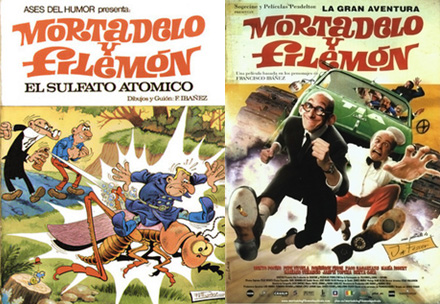
La gran aventura de Mortadelo y Filemón

Javier Fesser's universe drank a lot from Ibáñez's comic book, as short films and previous movies did reflect (Aquel ritmillo, El milagro de P. Tinto). So, Fesser was the rightest choice to move something as important as Mortadelo and Filemón's adventures to movie format.

The result had a brilliant prologue, fabulous staging, homages to heroes of national comics (Anacleto, a great gesture to 13 Rue del Percebe or the joke of a fascist Rompetechos) and a very irregular but funny development. Now, the unhinged reference to Indiana Jones and the last crusade made the audience's ass a one-thousand piece puzzle.

Miguel Bardem would take charge of a forgettable sequel with far much less knack. 


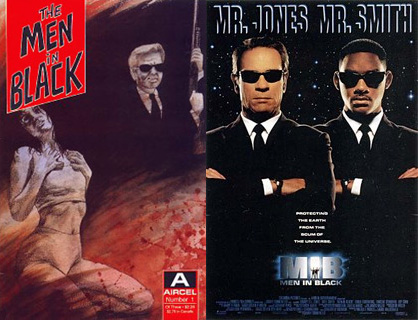
Men in black

Real beaten by critics who weren't able to get its touch of cartoonish humor, the tape, that told J and K's adventures, was based on some 90s pages of such a brief life (three issues), that introduced some men in black quarreling demons, aliens, mutants and all kind of paranormal monster. For the movie they just kept the alien part, and they replaced such politically correct details as the witnesses' murder with other more familiar options in the shape of memory flashers. It suffered a less funny and interesting sequel with the gallantry of having Johnny Knoxville in the cast and a Michael Jackson's cameo.

Blueberry

Jean-Michel Charlier and Moebius invented Blueberry on paper, a cowboy with Jean Paul Belmondo's features and some MacGyver's glimmers right in the West.

The Frenchman Jan Kounen (who had just directed the violent Dobermann) took charge of the adaptation on the big screen. The problem was that before the trip the man was getting peyote with a shaman, and thanks to that the movie turned into lysergic nonsense pretty much like a drag with Vincent Cassel, Juliette Lewis and Michael Madsen that only conserved from the original referent the name of the main character. A misfortune.


A history of violence

Cronenberg's thriller starred by Aragorn/Alatriste was applauded by a large part of the critics, who thanked that the director stepped away from his new flesh obsessions and people with meat complements where to plug the iPod in.

The story is based on a graphic novel of identical title, but the director himself claimed that he was unaware of that piece of information until they got to work in script re-writing during the pre-production.


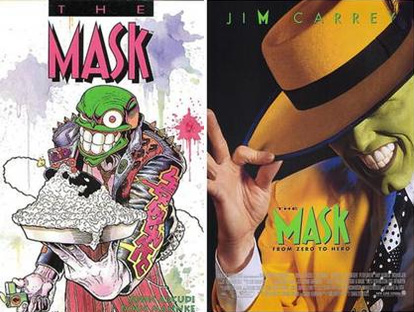
The mask

It was 1994, Jim Carrey didn't look terribly tiring yet and the audience was surprised about that amazing technical demo of the special effect that was the The mask movie. Its origin was in a comic of similar premise (a mask which gives powers to the one who finds it) but with worse drool: the original cartoons made ultra-violence their leitmotiv and the mask's carrier tended to begin in series massacres and to murder all who bumped into him, lovely details that, curiously, were removed from the movie. Decency and the politically correct thing, as always, taking so many funny things from us.

Garfield

The move to celluloid of the chubby feline that reigned in the comic strips created by Jim Davis couldn't have been more disastrous: trashy mixture of Garfield generated by computer and live image. Bill Murray recognized in an interview that he accepted to make the cat's voice because when he was passed the script he confused the Joel Cohen who signed it with the Joel from the Coen brothers (learn, for God's sake, the Fargo's is spelled without an aitch). Now, he cheerfully participated in the sequel.

Years later, on the Zombieland tape, Bill Murray performed himself and, in a certain moment of the film, after being shot, he's asked if he's got something to regret. "Garfield", he replies. And with good reason.

We'll continue on Volume 2.

martes, 5 de julio de 2016

"Scott Pilgrim", review of the six volumes


Self-portrait of the author, Bryan Lee O’Malley
Bryan Lee O'Malley has a hardened ass for sitting in front of the game console next to Italian plumbers and blue echidnae, he's a keen manga comic devouring guy and he's passionate about music. With such a fine cultural rehash he gave birth to Scott Pilgrim, or the romantic deeds of a Canadian in his twenties whose universe is governed by the laws of video game.

The proposal cold like that sounds as productive as building a cathedral out of pillows, but O'Malley is a man who came from publishing an introspective graphic novel (Lost at sea) about an asocial girl who is convinced that her cat stole her soul.
This guy would be capable of turning Pacman into the inner monologue of an Asian who, by treating himself, faces the ghosts of the past.
And with Scott Pilgrim he gets something special.
The work presents forms of manga (black and white, pocket-size form, simple dynamic lines), it possesses slice of life spirit, it plays self-reference (the characters talk about events happened in time by quoting the volume during which they happen) and it has an aftertaste of mature pixel.

A homage to those who cultivated little thorns during the 80s and 90s, Scott is the reflection of a generation that's been the closest to a conflict during a quarrel in a bar or on disc 3 when quarreling Sefirot.
Fun, cock-and-bull stories, concerts, video games... nostalgia to the rhythm of guitars in 8 and 16 bits.
Scott's feat is epic, he's a hero of his time: a slacker, shameless, a scrounger, a person who cries if his roommate deletes his game on Final fantasy II, a guy who wants to win the girl of his (literally) dreams over and he does the beat 'em up way.
In any other time, in any other context, it wouldn't make sense.

Scott Pilgrim's precious little life.

Scott Pilgrim is 23 years old, he lives in Toronto, he plays bass guitar in a group called Sex Bob-omb with his friends (Stephen Stills and Kim Pime), he burns hours clinging to the game console, he's dating an Asian who goes to his high school (Knives Chau), he sleeps with his gay roommate (Wallace Wells) because they only have one mattress at home and an Amazon deliverywoman that he's obsessed with has sneaked in his dreams.

Scott doesn't know what he wants: to keep the comfortable platonic relationship with the Chinese teenager or to win Ramona Flowers over, a mysterious ninja skater who uses the hero's head as a delivery shortcut at nights.
This first contact with Scott's world takes little to fool around with the fantastic genre through doors that lead to subspace hitchhikers or a rock band with a theme song in their repertoire that leaves the public in a coma, but in their essence they keep deeply costumbrist bearings, focusing the attention on the relationships in Scott's little group of friends (where Wallace Wells, the gay buddy, stands out stylishly sharply) and giving an impression that the story gets along with elegant comic forms of everyday tone. But only until the reader's testicles are invited to meet the ground when, during the last third of the book, someone gets in by blowing up the roof, challenges Scott a duel to death, invokes an entourage of winged hipster devils and the thing rambles on a choreographed Street Fighter.
The truth is disclosed: if Scott wants to go out with Ramona first he'll have to defeat her seven evil ex-boyfriends.
Scott's life has an end, bosses.
Scott's life has a video game's rules, the reader has just noticed. He was slipped it, all the way to the bottom and with malice. Bryan Lee O'Malley roars resoundingly with laughter.

The drawing isn't very finalized but the proposal hooks. The final nonsense unsettled critics that didn't know which hand to grasp the ensemble with and encouraged the medium reader. Even so, this first volume isn't the top work of art that four fanboys with their panties in their hands proclaim, but it does look a splendid beginning for the series.

Scott Pilgrim vs. the world.

The bases set in the first delivery, the second one affords rave since the start: it begins by recalling the Pleistocene of game consoles and it continues with a flashback of pure Final Fight in Scott's childhood.

The plot rummages in the past and the relationships of the supporting characters more in-depth and with certain understanding, but at the same time it makes clear at the top of its lungs that anyone in this work can start taking impossible jumps, kindly toughen their lower back based on blows 卧虎藏龙 style or quote Guybrush Threepwood.

Scott now has pending ventures to face: deal with his relationship with Knives, eliminate Ramona's second evil ex-boyfriend, Lucas Lee (real famous movie star sold out to the highest bidder and formerly a skater) and survive to the reunion with a super rock star ex-girlfriend (great telephonic conversation and its comatose effects).

And O'Malley's scrotal sac is exclusively composed of mithril because he closes the volume with a major cliffhanger.

Notable is the knack to combine the sensitive part and the bits of everyday life (like that recipe of communal vegetarian turnover) with the hallmark off-the-hooks. More ability, skill and wise moves are seen in the composition of pages and the rhythm, with an author who starts getting the point of narrative and he manages not to disappoint if you enjoyed the first one.

Scott Pilgrim and the infinite sadness.

Besides having the most awesome ever title, this issue supposes the biggest rave of the saga. O'Malley cuts loose by covering the return of Envy (cover of the issue and Scott's lethal ex-girlfriend) with everything that comes to his mind: girls who play drums with a bionic arm, some department stores with such exquisite offers that putting a foot inside may mean to die, points to save the game, bands that play without any instruments by manipulating sound waves ("through effort and goodwill" [sic]), rewards in the shape of extra lives, and a new evil ex-boyfriend: Todd; a moronic rock star that, thanks to a vegan diet, possesses mental superpowers and casual hair Son Goku Super Saiyan style.

The remix of rhythms come out well: the main character doesn't only physically quarrel an enemy, but psychologically the trauma of the reencounter with his ex-girlfriend. The author appears to have learned to finally draw and he creates the most perfect volume, 'cause it's sassily crazy, of the series. He even scores shamelessly an impossible deus ex machina to wrap the fight with Todd up and we don't care because we're having great fun.
As a detail some extra pages with reinterpretations of the characters by other artists and a really brief musical note are included (anecdotal: some mere lines in a box) by way of possible soundtrack of the main characters.

Scott Pilgrim gets it together.

After the overloading of paranoias from the previous issue, here the tone relatively relaxes. The first surprise of the issue consists in coming across a very nice beach but excessively brief prologue in full color.

The story gets a friend of Scott's past back and takes calmer ways by exploring the interpersonal relationships. Now, it starts bugging that the characters are drawn in such a similar way (the female ones share fashion designing in eyes and the shape of their face which, added to the absence of color, makes Kim, Ramona, and Lisa —new arrival— be different in the fact that the first one has four freckles, the second one some aviator glasses on her hair and the third one double eyelashes). In addition there is a gender surprise in Ramona's new ex.
But after the epic of Volume 3, this fascicle's not enough. It's less balanced and the excesses go secondly. Yeah, we've got swords, pastries implied in more than a female subject, a character that when exploding frees kittens and little birds such as a villain from Robotnik; subspaces via a starry door and a mysterious Chinese man who goes around cutting buses with his katana as someone that slices chopped meats for a snack, but the story would rather focus on the most important achievements: to get a job (which awards experience bonus), to deal with Ramona's jealousy and to talk to the landlord of the apartment.
The pure pixel art back cover (a Miguel Sternberg's work) is real thoughtful and the instructions of the (next-to)-last page about the direction to read the comic in are an amusing gibe to the mangas sluggishly edited, but the book is the slackest in the ensemble.

Scott Pilgrim vs. the universe


The esthetic reverence is funny: if second volume included as a presentation in the shape of a logo a tribute to PC Kid, and the fourth one a genuflexion to Sonic, the fifth one has the courtesy of starting up with the sassy homage to Double Dragon.

Scott's life is changing, he turns 24 years old, his group has problems, the relationship with his girlfriend is getting complicated (and the habit to shine in a little compatible way with logic that Ramona's head has looks weird to everyone), he moves to another apartment to live alone and, if that were not enough, he's got a double portion of ex to beat in this issue: two Japanese twins who, honoring their national traditions, persist in sending robot enforcers against the hero. Scott kicks the lock in a background of fabulous alcoholic mellownesses based on tequila, themed parties to attend dressed up and some character locked up in a cage waiting to be rescued by the hero.
This vs. the universe is read quickly (probably thanks to less quantity of dialog and more dynamic cartoons than in previous issues) and rises up around volume 4, but it makes clear that the third one will go down in history as the most inspired one.

A bitter ending and a new awesome cliffhanger leaving a fan higher than Charlie Sheen celebrating New Year's Eve in Medellín.
As a reward, a little making-off on the final pages. And a special mention to the screen shots (created by Ben Bernsten) Nintendo game style that beautify the back cover (with subspace glitches included!).

Scott Pilgrim's finest hour

Final stage.
There are few things more bothersome than a smart-ass hipster.

Scott has been feeling like filing one of them's nose bridge something like five books: Gideon is Ramona's last mysterious ex, a winning smarty-pants with plasticene frame glasses.

In the last issue we find a beat sunken alone hero searching for himself and posing sex to every female who was important in his life till he gathers enough courage to face his fears (which acquire the shape of NegaScott: a dark huge version of himself that had briefly appeared in previous issues) and he heads toward the definitive battle against Gideon, a total final boss who has been fucking over in the shadow during all the series and (as every diabolical being that's appreciated) has set a bar for modern guys.
Final chapter with more pages than usual for the occasion; summit of the esthetic design of the series and centered on a battle in the bad guy's den that, on surrendering to the presumed epic moment taking most of the book, becomes excessively long and make the digestion of the volume drowsy.
It closes up with an agreeable epilogue that relocates the supporting characters in their place and it provides them with a future, including an unexpected (and little insinuated) coming out of the closet.

Last and definitive issue, slightly disappointing for those who expect a more inspired impression outcome, but a more than correct and, deep down, worthy closing for a notable series.
Game over.
Bonus stage!

Free Scott Pilgrim

On the official webpage of the series, Bryan Lee O'Malley was so kind as to share a little short story of 17 pages that happens between Volume 3 and 4 with Scott and company on their way to the movies to watch Brokeback Mountain. Other brief unpublished (pretty anecdotal) cartoons without much weight but that's used as a curiosity for a fan are included, too.

domingo, 3 de abril de 2016

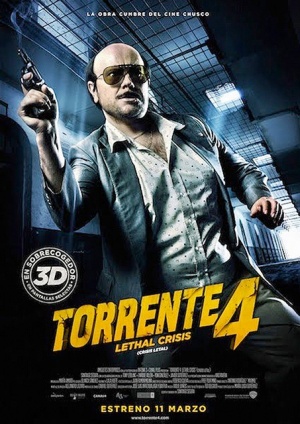
"Torrente 4: Lethal Crisis"

Chuscoexplotation.
The first Torrente was amusing itself by exploiting a humor gold mine that many didn't dare to touch on; its sequel was the same joke with more means and located in Marbella, but Torrente 3: el protector became an authentic piece of nonsense in favor of the excessive display of cameos (with some unheard-of ones, such as Oliver Stone's or John Landis's). At this point it may be reviewed the fourth film is better than the third one. But this comes to be like considering that slitting your finger is better than cutting your entire arm off.

Opening a movie with María Patiño is a symptom that something's very messed up in the world. Santiago Segura reuses the screen as a catwalk by saturating it with famous faces, in large part gotten out of the select of junk TV. After some notable credits, the film opens its legs to a chain of stiff gags while the ensemble's hands are tried to be tied with the excuse of a Torrente entrusted to commit an unclean errand, jailed right after and hatching a jailbreak plan like slum Michael Scofield in an insane prison. Not even the homage with smell of chorizo to Victory exempts the work from its basic little risky nature: Santiago Segura keeps extracting oil from an icon that's long ago dead, laid to rest and breathing lime. A Torrente that gets as much those who sympathize with the character as those who it grosses them out to drag them to the movie, even though on the way he forgets to tell a story, at least Bondian, like in previous films.

Excessive foreseeable cameo festival (Carlos Areces, Ana Obregón, Fernando Esteso, Carmen de Mairena, Kiko Matamoros, María Lapiedra) with two esteemed mentions: the villain (just to hear my own voice), played by the singer Francisco and That One Whose Name Must Not Be Pronounced, both starring in a tight fight on screen for the title Do it worse with the least number of lines. The only good thing that could be said about casting/guest-star choices like these (one for the director's whim and the other one for pleasing trashy public) is that at least they said the words they got in the right order. Paquirrín, on his behalf, appears making of casual colleague and he gets one to be aware of the degeneracy of the partenaire during this saga: something that started with actors (Javier Cámara and Gabino Diego) continued with a comedian (José Mota) and led to this.
What does look hilarious in a wicked way is the 3D packaging. Filming the filth in stereoscopic format doesn't stop being something similar to hiring the Berlin Philharmonic to perform Paquito el chocolatero. Now, the action sequences are a lot scarcer (anecdotal) and less spectacular than in previous films.
Thinker, philanthropist, gentleman, hero: Torrente, the King of the Muck.
But if we've got to recognize something to Segura is his fabulous ability of self-advertising. Many could learn that in order to formalize a national industry you've got to sell the junk as if it were gold. The Americans do it well since forever. And for it a mere note: more than two million spectators have payed for watching in this movie a shot of a rump with its majestic testicles hanging in startling 3D.
More than two million.
A rump.
Testicles.
Hanging.
Bravo!


domingo, 27 de marzo de 2016

Niño y Pistola as Arthur & The Writers

The Galician Niño y Pistola put themselves in Arthur & The Writers's shoes to drop by the American West coast and thus pay tribute to the great ones. A cared for production and an evolution of their sound give us a record that's difficult to believe it to be of 2010; ideal as a soundtrack in a coast to coast via a Mustang.