Mostrando entradas con la etiqueta English. Mostrar todas las entradas
lunes, 20 de abril de 2015
A conversation
As the EDGE interview has been doing once a year since 1998, it has given the world its annual question. The question of this 2015 states: "What do you think about the machines that think?". Or what it's just like it: "What do you think about artificial intelligence?". There is in its interesting web page a large army of scientists, writers and philosophers trying to figure out presence of future time, the one that will come, in our present and stuff like that.
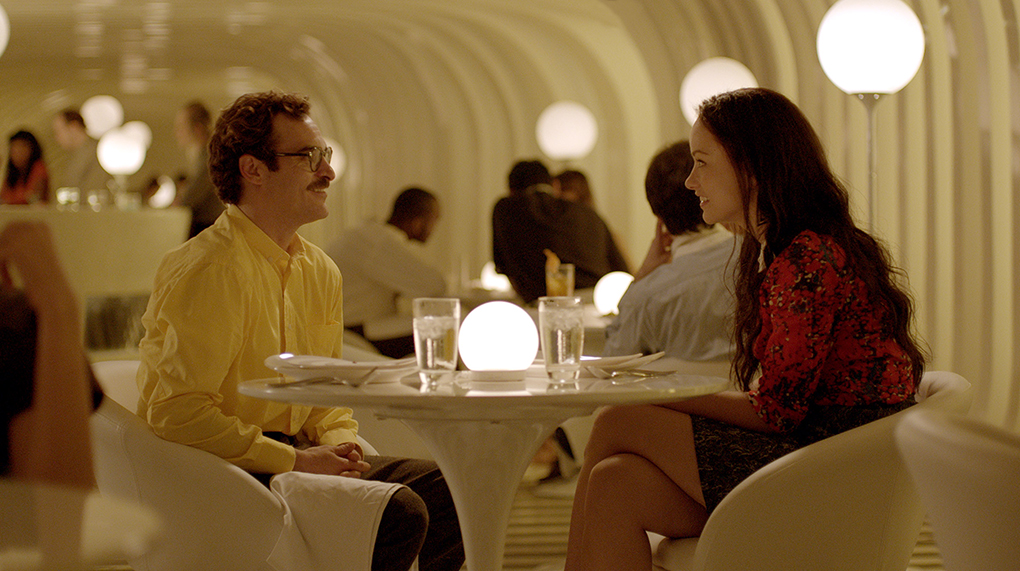
It's been thanks to the EDGE's question that I've looked over the best movie I saw during the year 2014 again: the great Her, directed by Spike Jonze and starred by Joaquin Phoenix and Scarlett Johansson's voice-over. In Her, the leading role, Theodore, a solitary guy who writes letters for others for a living falls in love with Samantha, an operating system programmed to satisfy all needs of the user and which the director and screenwriter's imagination supplies with conscience and female gender.
Hundreds of reviews have been written about Her. Most of them theorize about our relationship with machines that think and make projections about social changes that will come when artificial intelligence inundates our lives.
However, Her still delights me for the opposite, because it's a terrific vindication of the most fiercely human element: word. And specifically, of word as a basic pillar of sentimental relationships. Her asks for the central role that conversation must take up in loving relationships and that it has been sneaking away. Nothing older or more everlasting. Theodore, the solitary leading role, doesn't fall in love with Samantha's tranquil and warm voice. He falls in love with a dialog, with an interpretation, with someone who talks to him and helps him get over his emotional conflicts. Her is, first of all, a resounding memory of the power that affective bonds have on pure corporal attraction. Because the voice Theodore falls in love with lacks a body but he gets the feeling of being loved, listened to, and understood. We live among more and more intelligent machines, in more and more sophisticated cities, and in bodies mistreated until reaching the ebony level. But we inhabit a world destroyed by lack of communication, points out Spike Jonze, on account of the antihero Theodore. The Uruguayan writer Ida Vitale said so not long ago: "La información está sobrevalorada. La gente está dentro de sus casas pero fuera del mundo".
So if we want a sentimental relationship to be possible, word is the indispensable cement for it. This sacred commandment of affective life is certainly often reminded to me by my friend the writer José Lázaro with a Nietzsche's aphorism in Menschliches, Allzumenschliches. Ein Buch für freie Geister: "Man soll sich beim Eingehen einer Ehe die Frage vorlegen: glaubst du, dich mit dieser Frau bis ins Alter hinein gut zu unterhalten? Alles andere in der Ehe ist transitorisch, aber die meiste Zeit des Verkehrs gehört dem Gespräche an". A conversation. It turns out that marriage is held up by a warm, unhurried, endless conversation... A conversation... Love is a long conversation. Like the one that Theodore and the Operating System Samantha have in Her. Like the one that the poet Pere Gimferrer and his wife María Rosa Caminals struck up for thirty-three years until she died and he buried her during a fall twilight which was painted with gouache by Arcadi Espada, the best journalist in Barcelona. A free, with no emotional baggage, and aroused conversation, like the one of doctor Bruno Sachs with his girlfriend, told by the doctor and writer Martin Winckler from the waitress's eyes from a cafeteria where the couple meets in the afternoons: "Ils viennent presque toujours ensembles. Et quand ils sont ensembles, ils parlent. Ils parlent beaucoup, parfois, pendant un bon moment... J'entends parfois des bouts de la conversation. Ça commence: " Est-ce que tu sais ce qui s'est passé ce matin ? ". Et elle: " Dis-moi... ". Ils sont amoureux, et ça dure. Ça se voit dans la manière qu'ils se parlent... Ils ne regardent jamais autour quand ils sont assis à la terrasse; en échange, des autres couples ont l'habitude d'être un celui qui parle et un autre celui qui regarde autour, pour voir s'il reconnaît quelqu'un ou pour voir s'il est reconnu. Il avait l'habitude d'être taciturne et maintenant il en est moins à mesure que les mois passent". It turns out that it's a conversation that stabilizes our loves and gives us calm. And it does even though our technical world claims it really fast. But love is merchandise that can't be bought made. We need to know each other, we need to talk to each other unhurriedly and for a long time to create mutual understanding with each other and feel embraced, understood and defended.
All of this life fire, this homage to word, to its ability to hold the biggest love stories (Jacques Lacan felt sexually aroused while just talking to his disciples) is what Her is about, a weird, brave and very exciting movie. Simply, a movie spoken.
sábado, 4 de abril de 2015
Raising low salaries
McDonald's, Walmart and Target understand that recovery is also defended by increasing wages.
Big American companies consider that it's time to raise salaries. Not much, but enough for public opinion to receive the wave of optimism issued from the economic recovery. At the start, back in February, it was Walmart; then, Target, Walmart's competitor; now McDonald's pronounces itself, which is going to raise the salary per hour worked in its restaurants up to 9.9 dollars, that's 10%. TJMaxx and Marshalls. The salary starting point is low, but the arguments put forward to explain the rises matter, and a lot: there is recovery and that should turn into a reduction, even though testimonial, of inequality; growth is on a roll, unemployment diminishes, Janet Yellen is happy, and Obama has asked for the minimum wage to rise at least 10 dollars. These are general arguments; Steve Easterbrook, McDonald's's CEO has added another one very specific: his restaurants need motivated employees.
A great reasoning. Motivation is basic in competitiveness. Let's repeat it, for the record and so it's well understood everywhere: competitiveness doesn't improve lowering salaries or reducing employment, but, among other things, letting wage earners develop their work with the consciousness that they're well paid and they can aspire to be the best in their profession, with studies or without them. That idea doesn't touch deeply in that part of the Atlantic; incitements wind up in superior graduates. In the USA, they start from the beginning, or rather, from below.
Of course that —and these data are fundamental— union presence is low, social protection, scarce, and competitiveness, almost endless. In return, the enterprise is one more resource of global demand. McDonald's and Walmarts conceive that more salary is more demand and, therefore, more business, for them too. Expansion lives in the basement of the conscience; austerity lives in the European conscience's. Some popular psychologist ought to explain the European and American economic ways for the traumas caused by the Depression and the Hyperinflation. We are all slaves of our terrors.
miércoles, 10 de diciembre de 2014
Night war manual
Not the Hundred Years'. Not the Vietnam one. Not even the television audience one. By so far, the bloodiest war that a dated average man can endure is the one that he puts up every night to maintain his side of the bed.
Not all of them survive, truth be told. And to undertake this battle with certain victory guarantees, nothing better than follow the advice of this campaign manual that I provide you with, oh, my poor dandies.
1. A good initial deployment is fundamental. The officers experienced in a thousand and one night skirmishes know that the best posture always passes placing oneself sideways and diagonally. For it, the choice tactic is the one to nestle their face lovingly on the enemy's shoulder, just at the beginning of the contention. Result? You'll occupy almost all of the battlefield since the start and your enemy will have trouble to maneuver. This is a winner fundamental tactic in every battle for a good Sealy mattress.
2. Continue deploying your army well. Observe your body. Analyze it. Are you tall? Make the most of the rearguard area: your knees and your feet are your best weapons. Do you have some extra pounds? Then play with the intimidation factor. Your enemy will care a lot for stepping in involuntary rollings (or so she thinks). The slim ones count on the always effective leech tactic: sneak on the sheets through every gap they find and use their sharp joints by way of machine gun. Even the small ones can get benefit, as they withdraw easily on the edge and they can plan their next strategy tranquilly, to the sound of the snores of a too confident enemy.
3. Don't ever give a post up for lost. Doubtlessly, the war that is put up at night for each hand of the viscolestatic is an exhaustion war. If, for example, your arm barely holds out on the little piece of mattress that is left by your right side and you unexpectedly receive a new ramming from that pointed elbow, try to counter-attack with the filthiest strategy that comes to your mind. Raising your arm -as hinting that you submissively accept your defeat- at the level of your forehead and letting it fall distractedly on your enemy's head may make them pull back. An innocent yank of the eiderdown upwards with the intent to cover up doesn't usually raise suspicions, and it allows you to place, with a skillful waving movement, a fluffy and beautiful barrier that will protect you from future attacks (it requires practice). In any case, never stop fighting. Use all the means at your fingertips, fight for each hand of land. Did you ever hear about trench war? Well, this is the same thing, but in sateen white.
4. The multiple dirty tricks which the fighter may be a victim of for the whole night deserve a special mention. "Can you bring me some water?", "I can hear a noise downstairs", "Did you lock up?" or "Open the door to the cat, honey" are some of the most common, but there are many more. All of them pursue the same: snatch your side of the bed in the brief lapse of time when you, courteous warrior, carry the commanded tasks out. You will frequently come back with, let's say, the damn cell phone charger -forgotten in the living room, ha!- and you will find that she has gotten squashed in your side of the bed, she'll have fallen asleep, and you'll have to plug the cell phone in yourself groping. And on top of that, you'll make noise and you'll get a severe warning -as, since the Geneva Conventions, noise is considered a weapon even worse than the racism bombs in the war of full mattresses.
5. If all the previous fails, resort to the next tactic. Independent of the point of the battle you find yourselves in, sneak gently under the sheets. Take her panties down, slowly or all in one indolent go (this depends: know your enemy). Begin giving her little smooches -like wingbeats- on her thighs, and after an instant, put your tongue like a missile in her pussy. Do your best. If after a short while you check that she is sitting up and coming to your side of the bed with her eyes half-shut, you maneuvered well. Make love. Hold on tight to your hands, cover the battlefield with sweat. Shut your eyes and shout a lot. Take your breath between resounding kisses and euphoric future plans, such as purchasing a bigger house. Laugh. Hug. Tell her that you love her and she will confess you -ha- that you keep on fucking very well. She'll get up to go to the bathroom and she'll say that she's back with you right away. Glance at the door, which gives off a little thread of light. Hurry up and nestle sideways and diagonally.
miércoles, 21 de mayo de 2014
I apologize for having lived beyond my means
I apologize for having lived beyond my means, gaily, freely, without stopping to think for a moment that my reckless behavior would contribute, years later, to the economic and social hecatomb of this country.
I apologize for having studied a major, for even having dared to fantasize, in the future, I could have a better job than my father's, Post-War period child and mechanics with no vocation at the already ceased AMC. I apologize for having used up hundreds of dollars in enrollments, books, pens, and sheets. And for having wasted the five dollars my mother gave me for a sandwich, which should always have been a peanut butter sandwich and never ever (God, shame on me) a cheese sandwich.
I apologize for having meant to work in something vaguely related to my studies or, at least, minimally qualified so that five years based on peanut butter sandwiches and some cheese sandwich (I squeeze my spiked belt again) had been worth it. How many means of living in accordance with my means I wasted! Telemarketing phone operator! Pollster! Spanish academy's advertising deliveryman! Putting letters into envelopes! I had, my goodness, my own future in my hands and I discounted it in a justifiable fit of pride, thinking that these fine activities were casual jobs! I apologize (I'm typing on my knees now, looking at the wall) for believing I deserved something better.
I apologize for having covered my body with clothes. Forgive me, I beg you, for every dollar invested on H&M. Why didn't I wear ponchos? A poncho is elegant, decent, and entirely compatible with my means. You take a sheet, make a hole for your head and that's it. I could have dyed the Sunday one with some color, even the riffraff has to afford coquetry once in a while. But… T-shirts? Blue jeans? Jackets? And (oh, God, take pity on me) an overcoat every two winters? But who did I think I was? A marquis? A football player? A human interest anchor? I'm now sinking the cutter in my forearm and staring at the blood running, because any suffering isn't enough to repay that many nasty things.
I apologize, I apologize, and I apologize. And I will accept any punishment the markets want to give me in these ruthless justice days. I apologize for having had an average range computer, for having asked for that import drink at my brother-in-law's wedding, for having invited to a VIP dinner to the girl I liked (you've got to deserve even the Crazy Nights 2x1 offer) and for having asked for a loan to study a master's degree, for having bought that viscoelastic mattress and not that one of iron springs, which is the one which belong to the ones from my caste; I apologize for having lived, once in a while, moderately unworried, for not having thought, restlessly, from day to night, about the future; for having read poetry, and not economics books; for having loved, laughed; and for having endured the terrible disease of wishful thinking.
And it's just that, now that I think about it, now that I watch the news broadcast and I read the last analysis of the recession and the consequences that spendthrifts like me are going to endure with all justice, I realize that I haven't lived beyond my means, but in the atmosphere, in the stratosphere, in the fucking leap to hyperspace of my means…
I didn't have any!
Suscribirse a:
Entradas (Atom)